MBFX Risk Management Guide: How to Protect Your Trading Capital
Risk management is the difference between traders who survive and traders who disappear. Learn how to protect your trading capital with the 2% rule, position sizing, and stop loss strategies.
MBFX Risk Management Guide: How to Protect Your Trading Capital
I've been trading forex for nearly a decade. Risk management is the difference between traders who survive and traders who disappear.
When I started, I was that guy. Saw a setup, went all-in. Chased losses by doubling down. Thought bigger leverage meant bigger gains. Blew my first account in three months. The second one lasted six months. It wasn't until I lost enough money to actually hurt that I started paying attention to the rules everyone kept mentioning but nobody followed.
That's when things changed.
The Math Problem Nobody Wants to Face
Most beginners don't realize how losing money actually works. You have $1,000. It drops to $500. You think you lost 50%. Wrong. You lost 50% of what you had. To get back to $1,000, you need to make 100% on what's left.
Lose 75%? You need a 300% gain to recover. This is why accounts blow up so fast and recovery takes forever.
Risk management isn't about being a coward. It's about understanding that protecting what you have beats swinging for the fences every single time.
The 2% Rule
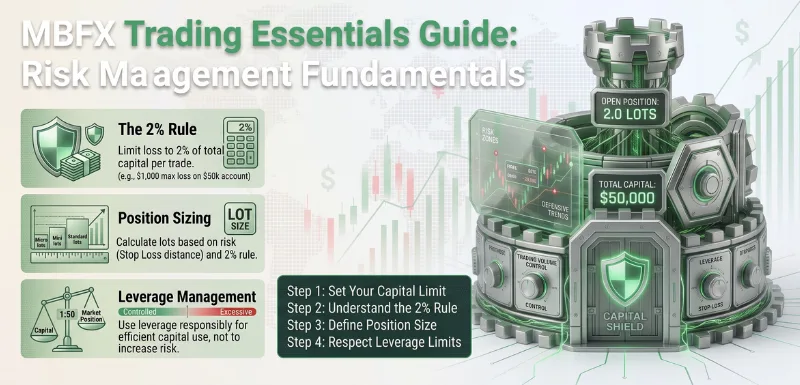
When I got serious about trading, I learned the 2% rule. It's this: never risk more than 2% of your account on a single trade.
Real numbers. You have $10,000 in your MBFX account. That's $200 at risk per trade. Your stop loss is 200 pips on EUR/USD. Standard lot, standard risk.
Here's why 2% works. Even if you lose 10 trades straight, you're down to about $8,200. Not fun, but you're still trading. You can learn. You have runway.
Risk 10% per trade? One bad week wipes you out 50%. Now you're grinding back from a massive hole.
Position Sizing: Where Most Traders Mess Up
This is where I see failure happen. Everyone knows about stop losses. Everyone's heard of risk-reward ratios. But position sizing? That's what separates survivors from blowups.
The formula is basic: (Account Risk ÷ Risk Per Pip) = Position Size.
Account is $10,000. You're risking 2% ($200). Stop loss is 50 pips. That's $200 ÷ 50 = $4 per pip. On MBFX, that's 0.04 lots or 4,000 units.
But here's the thing: your stop loss changes with every trade. Sometimes 30 pips, sometimes 100. Position sizing keeps your risk locked in at 2% regardless.
Most traders reverse this. They pick a position size first (usually too big), then stick their stop wherever it fits. Then they wonder why one bad week wipes them out.
Leverage: Why It Doesn't Matter How High It Goes
MBFX lets you leverage up to 1:500. That's exciting until you realize leverage doesn't actually change your risk.
Leverage changes the size of the position you control with that risk. That's different. It's actually useful—smaller lot sizes, more precision, tighter stops. But it's a weapon if you don't understand it.
A 1:100 leverage position sized wrong is just as destructive as a 1:500 position sized the same way. The problem was never the leverage number. It was always the position size.
I use leverage to fine-tune my positions. 0.01 lot on 1:100 gives me about the same exposure as 0.05 lot with no leverage. The leverage just lets me be more precise. Forces better decisions.
Most traders use it to trade bigger. That's the blowup move.
The Risk-Reward Ratio
Here's what breaks traders' brains: a 40% win rate is profitable. A 70% win rate loses money. It all depends on risk-reward.
You risk $200 and make $500 on winners, you only need to win 28% to break even. Risk $200 to make $300, you need 40% winners. The numbers change everything.
I aim for 1:2 or 1:3 on most trades. Risk $200, target at least $400, often $600. But I don't chase that ratio. I place it based on what the chart shows. Some days it's 1:1.5. Some days it's 1:3. You take what the market gives.
What matters: over 100 trades, your average is above 1:1. That alone, with a 40% win rate, makes you profitable.
Stop Losses
I watch traders place stops with no logic. Fifty pips away because "it feels right." Or they want to "give it room."
Your stop should be based on the setup. Not your fear of loss.
Trading a breakout? Your stop is when price hits the 4-hour moving average. That's where the logic breaks. Reversal off support? Stop goes below support. That's the rule breaking point.
The number of pips doesn't matter. Why you picked that number does.
I've put stops 200 pips away when the setup required it. I've put them 20 pips away when that was the correct level. MBFX lets you set your stop before you enter. Use it. Every trade. No exceptions.
Keep a Journal
I write down every trade. Wins and losses, but I study the losses first because they hurt more.
The journal has: entry price, entry time, exit, P&L, stop loss, why I entered, what surprised me, what I'd do different. That's it.
After 200 trades, patterns emerge. You see what actually works in your hands. You see where your discipline cracks. You see the exact moment you should have exited.
More useful than any course. MBFX's statement export makes it easy. Pull it, fill in the "why," review once a week. Three months and you've learned more than most traders do in years.
The Losing Trade Reality Check
I know traders who rage at losses. They revenge trade, break their rules, blow up.
Here's what they miss: if you size right and your risk-reward is good, losing trades are just statistics. A 40% win rate with 1:2.5 risk-reward isn't failure. It's a business model.
Losing trades happen. They're not personal. They're not the market against you. They're just cost of doing it.
The moment you accept that is the moment you stop breaking your rules.
Here's What You Do
- Calculate 2% of your account. That's your max risk per trade.
- Pick one pair. Paper trade for two weeks. Size positions using the formula above.
- Start a journal. Write down every trade.
- After 50 trades, review. Look for patterns.
- Once you're profitable on paper for a month, move to micro lots and real money.
Risk management isn't glamorous. It's the foundation. Without it, you're just finding faster ways to lose. With it, you have a business.
Trade smart. Keep your capital.
by MBFX Team